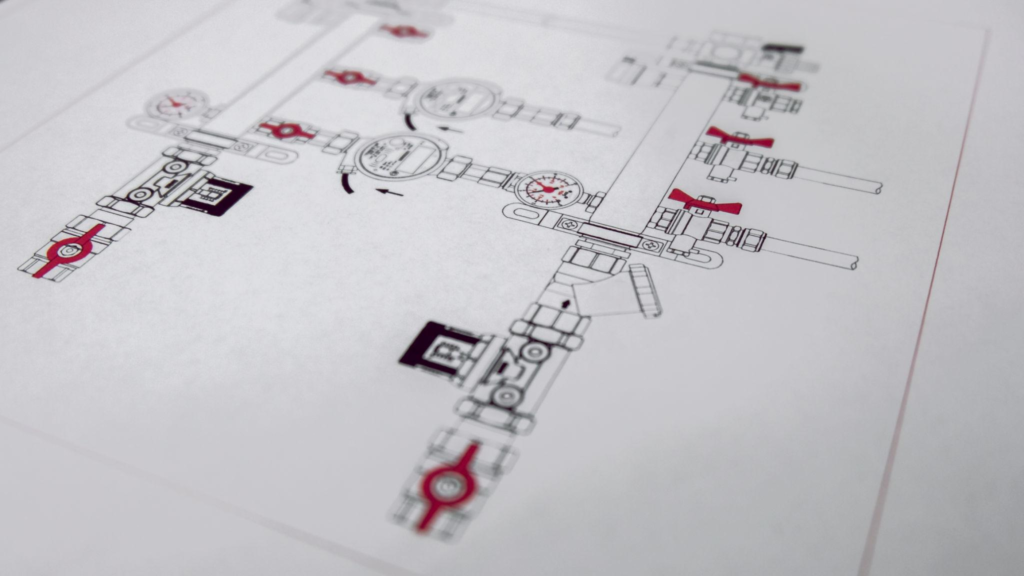
Modern MEP systems no longer fail because of incorrect geometry. They fail when engineering calculations are disconnected from spatial coordination.
In building design today, MEP systems are not just routed through available space. They are performance-driven networks where airflow, pressure, flow rates, electrical loads, and system capacities must align with real-world operating conditions.
As projects move toward BIM-driven workflows and integrated design environments, the gap between engineering calculations and spatial modeling becomes a critical risk area.
Individual systems may appear correctly designed in isolation. Yet performance failures emerge when calculations are not continuously reflected in the coordinated model. These failures are rarely modelling errors. They are typically the result of separation between engineering logic and spatial execution.
Understanding how MEP systems transition from geometry to performance requires examining how HVAC, plumbing, and electrical engineering calculations are integrated within BIM environments.
HVAC Engineering Integration
In HVAC systems, geometry alone does not determine system success. Performance depends on thermal and airflow calculations that must be continuously aligned with spatial constraints.
Key engineering inputs include:
- cooling and heating load calculations
- static pressure analysis
- duct sizing using equal friction method
- air balancing requirements
- equipment selection and efficiency optimization
When these calculations are integrated with BIM models, system behavior becomes dynamic rather than static.
- duct resizing automatically reflects spatial routing changes
- pressure losses adjust based on actual route geometry
- equipment clearances are validated against real placement conditions
When engineering logic is separated from spatial coordination, HVAC systems are forced into design compromises. These compromises often reduce efficiency, increase energy consumption, and create uneven system performance.
Plumbing Engineering Integration
Plumbing systems rely on gravity, pressure balance, and demand-driven flow behavior. Without engineering integration, spatial routing alone cannot ensure functional reliability.
Key engineering factors include:
- pipe sizing based on demand calculations
- gravity slope validation for drainage systems
- pump head and pressure calculations
- backflow prevention zoning
In a BIM-integrated workflow, these calculations directly influence spatial outcomes.
- invert levels are maintained consistently across systems
- drainage slopes are validated within the model environment
- vertical stacks align accurately with shaft geometry
This ensures plumbing systems are not only coordinated in space, but also reliable under real operating conditions.
Electrical Engineering Integration
Electrical systems require precise calculation-driven design to ensure safety, capacity, and efficiency across distributed networks.
Key engineering requirements include:
- load calculations across distribution networks
- short circuit analysis for protection systems
- voltage drop analysis across cable routes
- cable tray fill ratio compliance
When integrated into BIM environments, electrical design becomes spatially and functionally validated.
- panel schedules are directly linked to spatial layouts
- clearance zones around switchgear are enforced in the model
- conduit congestion is identified early in design stages
This integration prevents installation-stage conflicts that typically arise when electrical calculations and routing are developed independently.
From 3D to 5D Engineering Intelligence
Modern MEP BIM is no longer limited to geometric coordination. It extends into multi-dimensional engineering intelligence.
- 3D — Spatial Coordination Physical alignment of systems within building geometry
- 4D — Construction Sequencing Integration of installation timelines and workflow planning
- 5D — Cost and Quantity Intelligence Real-time cost impact and material quantification
When engineering calculations are embedded within this framework, BIM evolves into a decision-support system rather than a visualization tool.
- accurate quantity take-offs based on live design data
- procurement forecasting linked to design updates
- cost impact analysis during design modifications
This enables design decisions to be evaluated not only for spatial feasibility but also for performance and economic impact.
Key Takeaway
When engineering calculations drive the model — not the other way around — MEP systems become predictable, measurable, and performance-driven.
MEP engineering is not just about fitting systems into space.
It is about ensuring that engineered systems perform reliably under real operating conditions.
Author Bio
Aditi Kane is an Architect specializing in MEP systems and BIM-driven design coordination, focusing on system integration, constructability, and performance-driven building engineering.