
Certification rework is one of the most persistent and costly problems in aerospace software programs. Despite well-defined standards, experienced teams, and formal review gates, many DO-178C programs still encounter late-stage findings that trigger rework, schedule disruption, and erosion of stakeholder confidence.
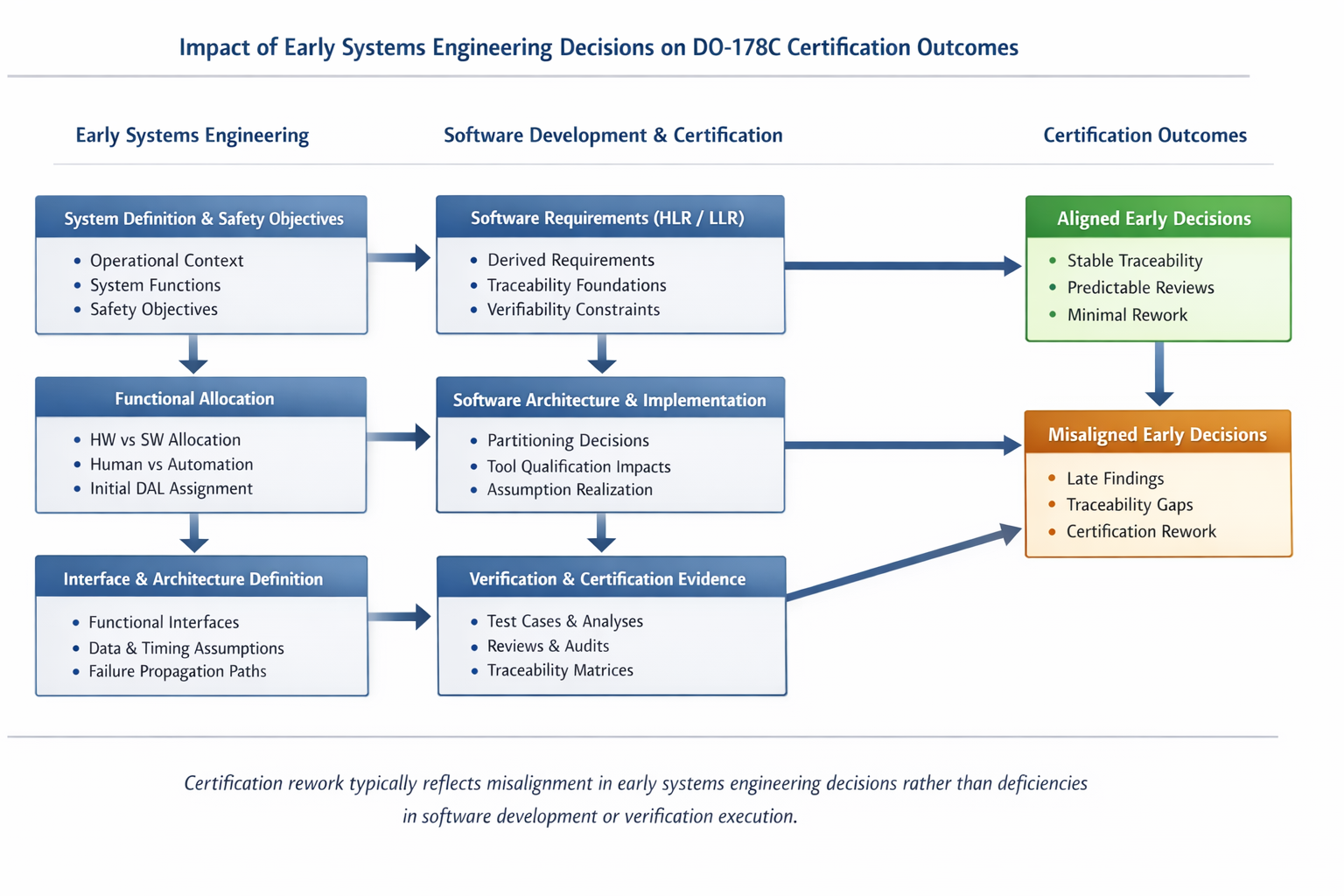
In most cases, this rework is not caused by poor execution or lack of process adherence. It is the consequence of early systems engineering decisions that were either incomplete, implicit, or insufficiently connected to certification intent.
Understanding and addressing this root cause is essential for improving predictability in modern aerospace programs.
Certification Rework Is a Systems Problem, Not a Software One
DO-178C is often discussed as a software-centric standard. In practice, certification success or failure is determined much earlier—during system definition, functional allocation, and requirement decomposition.
When systems engineering decisions do not adequately consider certification implications, software teams inherit constraints and ambiguities that cannot be resolved through disciplined coding or verification alone. Rework then becomes unavoidable, regardless of how rigorously later phases are executed.
From a program perspective, certification rework is best understood as feedback from earlier system-level decisions rather than as a downstream compliance failure.
Where Certification Rework Actually Originates
Across aerospace programs, several recurring sources of certification rework can be traced back to early phases.
Ambiguous or Unstable System Requirements
High-level requirements that lack precision, are open to interpretation, or change late in the program introduce instability into software life-cycle data. Even minor requirement shifts can cascade into significant re-verification effort.
Late Clarification of Safety Objectives
When safety objectives are refined after architectural decisions have been made, software components may no longer align cleanly with their intended Design Assurance Levels (DALs). Adjusting verification scope at this stage is costly.
Weak Traceability Foundations
Traceability is often treated as a documentation activity rather than as a design discipline. If trace relationships are not meaningful and intentional from the outset, they become brittle and difficult to defend during certification reviews.
These issues are rarely isolated. They compound over time, eventually surfacing as certification findings.
The False Separation Between Systems and Software
One of the most damaging assumptions in certification-heavy programs is the belief that systems engineering and software engineering can be cleanly separated.
In reality:
- System assumptions directly shape software behavior
- Software architecture reflects system-level trade-offs
- Certification evidence depends on consistent interpretation across disciplines
When systems and software teams operate with limited feedback loops, inconsistencies emerge. These inconsistencies may not be visible during development, but they become evident during audits and reviews, when alignment between intent, implementation, and evidence is examined in detail.
Treating DO-178C compliance as a downstream software concern ignores this interdependence.
Early Systems Engineering Decisions That Have the Greatest Impact
Not all early decisions carry equal certification risk. Certain systems engineering activities disproportionately influence downstream rework.
Functional Allocation
Clear, stable allocation of functions between hardware, software, and human operators is fundamental. Ambiguity here directly affects DAL assignment, verification rigor, and tool qualification decisions.
Interface Definition
Interfaces are not just technical boundaries; they are certification boundaries. Poorly defined interfaces introduce uncertainty in responsibility, verification scope, and failure mode analysis.
Safety Requirement Decomposition
The way system-level safety requirements are decomposed determines whether software requirements remain verifiable and traceable. Weak decomposition leads to requirements that are difficult to test and defend.
When these decisions are made deliberately and reviewed with certification intent in mind, rework risk is significantly reduced.
 Conceptual alignment with ARP4754A (Systems Development), ARP4761 (Safety Assessment), and DO-178C (Software Certification).
Certification Feedback Loops Must Start Earlier
Many programs treat certification engagement as a phase rather than a continuous activity. This approach delays critical feedback until design flexibility has already diminished.
More resilient programs establish early feedback loops by:
- Including certification considerations in system reviews
- Validating assumptions against certification objectives before design freeze
- Ensuring that life-cycle data reflects engineering intent, not just compliance checklists
This does not mean overloading early phases with documentation. It means aligning decisions with certification logic before they become difficult to change.
Managing Change Without Triggering Rework
Change is inevitable in aerospace programs. Certification rework becomes excessive not because change occurs, but because its impact is not fully understood.
Effective change management requires:
- Clear configuration baselines
- Explicit impact analysis across system, software, and verification artifacts
- Preservation of certification intent through controlled evolution
Programs that lack this discipline often discover the true cost of change during audits, when previously accepted assumptions are revisited.
Practical Guidelines for Program Leaders
From a leadership perspective, reducing certification rework is less about enforcing process and more about asking the right questions early:
- Are system requirements precise enough to support verification?
- Is functional allocation stable and defensible?
- Do software DALs reflect system safety intent accurately?
- Are traceability relationships meaningful, or merely complete?
These questions are uncomfortable early in a program, but far more costly later.
Certification as a Design Constraint, Not an Afterthought
Successful DO-178C programs treat certification as an integral design constraint, not as an external hurdle. This mindset influences how systems engineering decisions are made, reviewed, and validated.
When certification intent is embedded early:
- Rework decreases
- Reviews become predictable
- Confidence with authorities improves
Ultimately, certification outcomes reflect the quality of early engineering decisions more than the rigor of late-stage compliance activities.
Author Bio
Prasad Kane is Director and Co-Founder at Swax Engineering, with extensive experience in systems engineering, software-intensive aerospace programs, and certification-driven development environments. He has worked closely with engineering and program teams across the full development lifecycle, with particular focus on system definition, architectural decision-making, and alignment between engineering intent and certification requirements. His work emphasizes early rigor in systems engineering as a foundation for predictable delivery and reduced certification risk.